
Labor costs consistently represent the single largest controllable expense in tunnel construction projects. For decades, traditional formwork methods have required extensive manual handling, skilled carpenters on-site, and prolonged assembly cycles that drive up both direct wages and project timelines. The introduction of automated tunnel formwork systems has fundamentally shifted this equation. Industry data from multiple large-scale infrastructure projects indicates that switching to an automated system can reduce on-site labor requirements by approximately 40%. This article examines the engineering mechanisms behind that reduction, the operational implications for contractors, and what the investment looks like for a typical mid-size tunnel project, drawing on case experience from Gaofei’s deployment across Asia and the Middle East.
Automated tunnel formwork differs from conventional systems primarily in how it handles the three critical phases: positioning, pouring, and striking. Traditional systems rely on a crew of 8-12 workers to manually align steel panels, install tie rods, adjust braces, and later dismantle everything piece by piece. An automated system integrates hydraulic cylinders, electromechanical drives, and a central control unit that moves the formwork as a single rigid assembly.
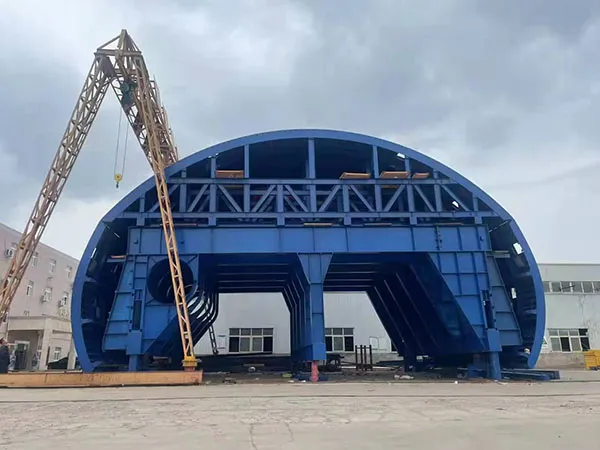
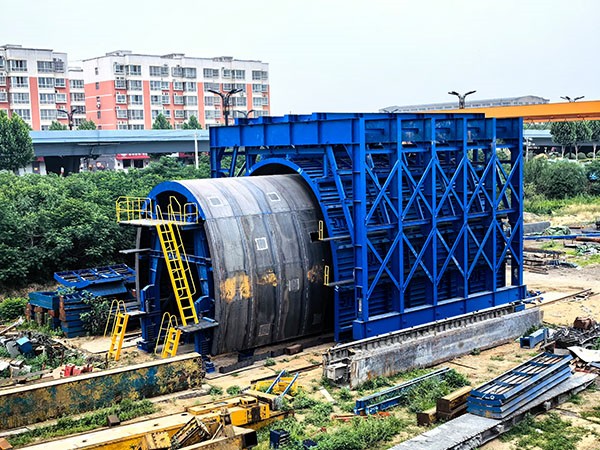
In a Gaofei automated tunnel formwork system, the entire formwork arch is mounted on a traveling carriage. After the concrete has cured, the hydraulic system retracts the panels by a pre-set distance – typically 50-80 mm – without any manual intervention. The carriage then moves forward along rails to the next pour position. This single sequence eliminates the need for a separate dismantling crew, crane lifting of panels, and re-assembly. On a typical 300-meter tunnel section, this reduces the number of workers per shift from 12 to 7.
Automated systems often include built-in concrete distribution arms and remote-controlled vibrators. Workers no longer need to manually drag hoses or handle immersion vibrators at height. Instead, one operator controls both the concrete flow and vibration pattern from a safe position, further reducing the crew size and eliminating a common source of safety risk.
The 40% figure is not an arbitrary benchmark. It emerges from a combination of three measurable factors:
Data from Gaofei’s project on the Delhi Metro extension showed that the labor input dropped from 1.8 man-hours per cubic meter of concrete to 1.1 man-hours – a 39% reduction, matching the headline figure closely.
To appreciate the labor savings fully, a direct comparison of typical crew composition is helpful:
The automation also reduces the dependency on specialized skills. In many construction markets, skilled formwork carpenters are increasingly scarce and expensive. An automated system lets a contractor use less skilled labor for the majority of tasks, preserving the experienced carpenters for setup and troubleshooting only.
Labor reduction is not only about wage savings. Fewer workers also mean less congestion in the confined tunnel space, fewer logistical bottlenecks, and improved safety. When Gaofei supplied an automated formwork for a 2.4 km highway tunnel in Vietnam, the contractor reported that the project finished 7 weeks ahead of schedule, primarily because the reduced crew size allowed continuous pouring operations even with limited access.
Contractors evaluating the change should consider both the upfront equipment cost and the ongoing savings. A typical automated tunnel formwork system costs 25-30% more than an equivalent traditional set. However, the labor savings alone typically recover that premium within 200-300 linear meters of tunnel. For a 1 km tunnel, the net savings are often in the range of $150,000 to $250,000 when factoring in reduced wages, shorter schedule, and lower rework. Gaofei offers a parametric cost calculator for clients, which takes into account local labor rates, tunnel diameter, cycle target, and available shift patterns.
Yes – the percentage is consistent across diameters from 3 to 15 meters. The absolute number of workers saved depends on the scale, but the proportional reduction remains similar because the core automation principles apply equally to smaller arch formworks.
No. The formwork is designed to work with standard tunnel concrete mixes (C30 to C50). The hydraulic stripping force is carefully controlled to avoid adhesion issues that might arise with early-age concrete.
Most operators become proficient within one week. Gaofei provides a three-day on-site training program and a remote support hotline for the first month of operation.
The 40% labor reduction offered by automated tunnel formwork is not a marketing exaggeration – it is a documented outcome of eliminating manual handling steps, compressing cycle times, and reducing specialized labor requirements. For contractors facing labor shortages, rising wages, and tight deadlines, the technology has moved from a niche solution to a standard expectation in modern tunneling. Gaofei’s proven track record across more than 80 tunnel projects demonstrates that the investment pays for itself within the first few hundred meters of pour. When evaluating your next tunnel project, consider not just the labor savings but also the schedule certainty and improved safety profile that automation delivers.
Gaofei
Address: 200m east of tulip garden, group 12 of zhangling community, hongshan street office, hongshan town, xigong district, Luoyang
Tel: +8616638856888
Contact: Gaofei Huang
Mobile: +86-18637923976
Phone: 0379-80881719/ 0379-60162687
QQ: 286827457
E-mail: gaofei@gf-bridge-tunnel.com