When selecting tunnel formwork for large-scale construction projects, durability often becomes the decisive factor between steel and aluminum. While aluminum is lightweight and corrosion-resistant, steel consistently outperforms it in long-term structural integrity, load-bearing capacity, and lifecycle cost. This article provides an evidence-based comparison to help contractors and project managers understand why steel tunnel formwork is the superior choice for demanding environments where strength and longevity matter most.
The fundamental difference lies in material science. Steel has a significantly higher yield strength—typically 250–350 MPa for structural steel versus 200–300 MPa for high-strength aluminum alloys. In tunnel formwork, which must withstand repeated concrete pouring cycles and heavy loads, steel retains its shape with less deflection. Aluminum, while strong initially, can experience permanent deformation under repeated high stress, especially at elevated temperatures (common in curing concrete).
Steel exhibits superior fatigue resistance. In a typical 1000-cycle tunnel formwork application, steel panels show minimal wear, whereas aluminum panels often begin to crack or warp after 300–500 cycles. Gaofei’s steel tunnel formwork systems are engineered with Q235B or Q355B steel (yield strength 235–355 MPa) and heat-treated to enhance durability, providing a service life 2–3 times longer than comparable aluminum systems.
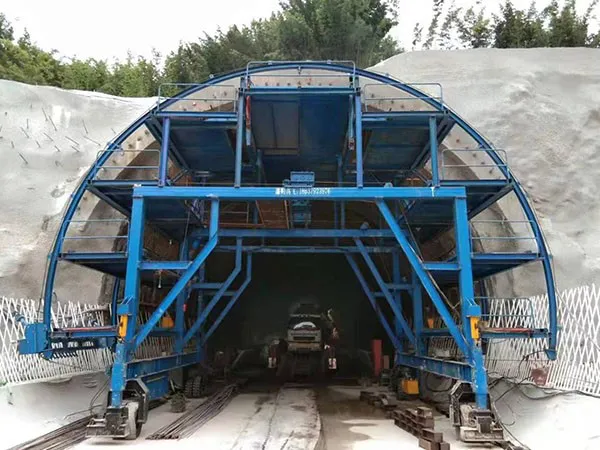
For tall tunnel sections (above 4 meters) or large spans, steel’s rigidity is essential to maintain dimensional accuracy and prevent slab sagging.
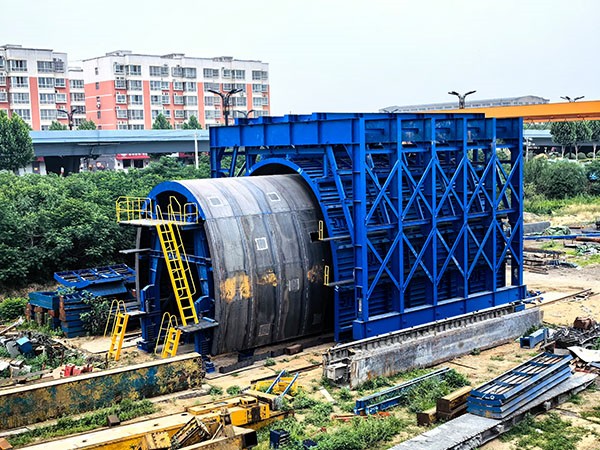
On construction sites, formwork faces constant abuse from rebar, concrete spillage, cleaning tools, and accidental impacts. Steel’s hardness (120–200 HB) is roughly 3 times that of aluminum (60–80 HB). This means steel is much less prone to gouges, dents, and surface scratches. Even with a protective coating, aluminum’s softer surface gets damaged faster, leading to rougher concrete finishes and reduced reusability.
Steel forms produce smoother, more consistent concrete surfaces because they maintain their flatness over hundreds of pours. Aluminum forms, once dented, create visible marks on the concrete—requiring costly patching and grinding. For exposed concrete (architectural finish), steel is the clear winner.
Aluminum naturally forms a protective oxide layer that resists rust, but this is often overstated. In tunnel formwork environments:
Furthermore, steel can be easily repaired with welding and re-coating; damaged aluminum often requires full panel replacement.
Initial purchase price is not the whole story. Consider these factors over a 10-year project:
| Factor | Steel Formwork | Aluminum Formwork |
|---|---|---|
| Initial cost per m² | Higher (~1.5x–2x) | Lower |
| Expected pours | 800–1200+ | 300–500 |
| Repair frequency | Low (every 200–300 pours) | High (every 50–100 pours) |
| Scrap value | ~30% of new | ~15–20% of new (due to alloy degradation) |
| Cost per pour (est.) | $0.8–1.2/m² | $1.5–2.5/m² |
Over 1000 pours, steel is 30–50% cheaper per use. Plus, steel formwork can be re-engineered for different projects by modifying panels—a practice Gaofei supports with modular designs.
Steel’s higher weight (78 kN/m³ vs 27 kN/m³ for aluminum) is sometimes seen as a disadvantage. However, for tunnel formwork that is usually moved by crane or hydraulic jacks, the weight is manageable. The added mass actually helps stabilize the form under concrete pressure, reducing vibration and improving safety. For repetitive tunnel segments, steel’s dimensional stability ensures consistent accuracy from pour to pour.
Steel is non-combustible and retains strength up to 500°C. Aluminum loses 50% of its strength at just 200°C—a critical factor in fire-prone construction environments.
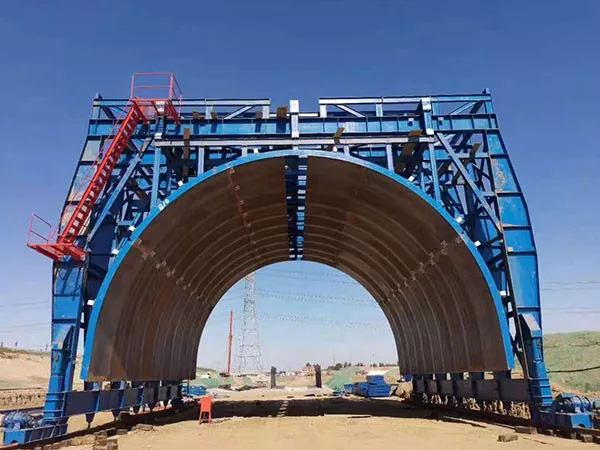
For construction firms focused on low total cost and maximum reliability, steel tunnel formwork is the clear choice. Its superior strength, longer lifespan, easier repair, and better concrete finish outweigh the lower initial cost of aluminum. Gaofei has supplied steel tunnel formwork for hundreds of projects worldwide, consistently delivering 800+ cycles per panel set. If your goal is to minimize downtime and ensure quality over multiple projects, choose steel—and choose Gaofei for engineered durability.
Q: Is aluminum ever better than steel?
A: Only in low-cycle (<200 pours), lightweight, or crane-restricted projects. For standard tunnel construction, steel wins on durability.
Q: How long does Gaofei steel formwork last?
A: With proper maintenance, 1000–1500 pours before major refurbishment, compared to 300–500 for aluminum.
Q: Does steel rust faster than aluminum?
A: Not if properly coated. Gaofei uses advanced galvanization and paint systems that outperform aluminum’s natural oxide film in alkaline environments.
Gaofei
Address: 200m east of tulip garden, group 12 of zhangling community, hongshan street office, hongshan town, xigong district, Luoyang
Tel: +8616638856888
Contact: Gaofei Huang
Mobile: +86-18637923976
Phone: 0379-80881719/ 0379-60162687
QQ: 286827457
E-mail: gaofei@gf-bridge-tunnel.com