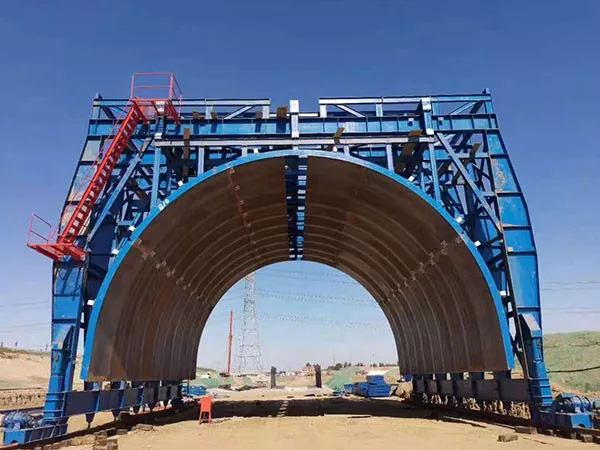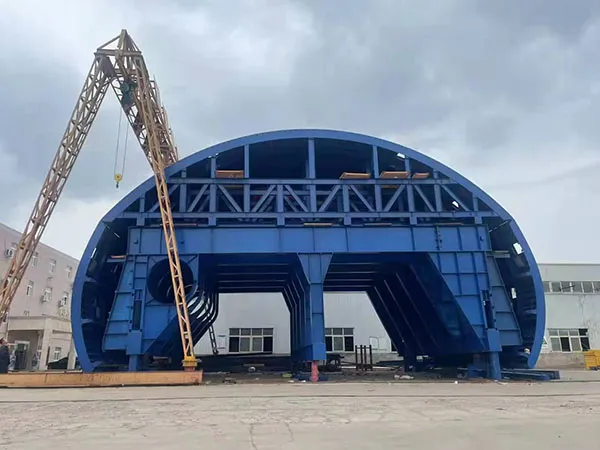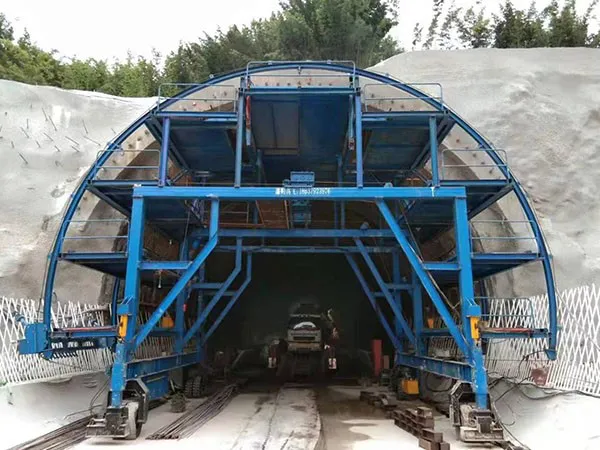
In the realm of tunnel construction and underground infrastructure, every decision affects safety, efficiency, and long-term durability. Among the most critical stages is secondary lining, the process of applying an additional concrete layer to reinforce tunnel structures. Traditionally dominated by manual labor, this stage has seen a dramatic transformation with the introduction of modern secondary lining trolleys. In this article, we explore the differences between conventional methods and these advanced trolleys, highlighting why many companies are embracing the shift.
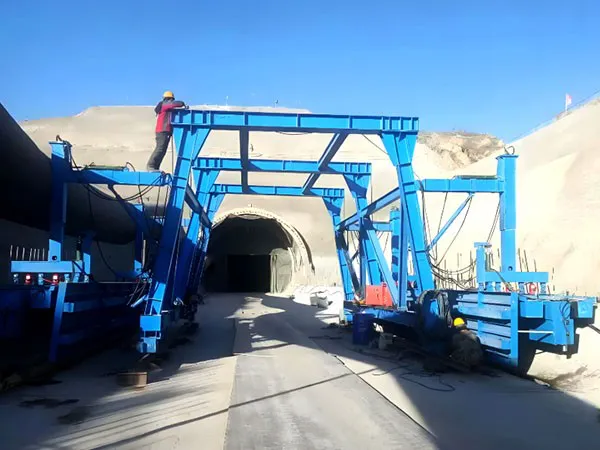
For decades, secondary lining relied heavily on manual labor and basic mechanical tools. Workers would install wooden or steel formwork, pour concrete by hand, and perform curing and finishing tasks using scaffolding or small movable platforms. While dependable, this approach presents notable challenges:
Labor-Intensive Operations: Large teams are necessary to handle formwork, concrete placement, and finishing. This not only increases labor costs but also exposes workers to fatigue-related mistakes.
Time-Consuming Processes: Each stage—setup, concrete pouring, curing, and finishing—requires careful attention, often slowing overall project timelines.
Safety Concerns: Working at height on scaffolding while handling heavy materials significantly raises the risk of accidents.
Inconsistent Quality: Achieving a uniform lining thickness and smooth surface relies heavily on the skill of workers. Variability can affect durability and structural performance.
Despite these drawbacks, traditional methods remain prevalent in smaller-scale projects or tunnels with simple geometry, primarily due to lower initial equipment costs and familiar workflows.
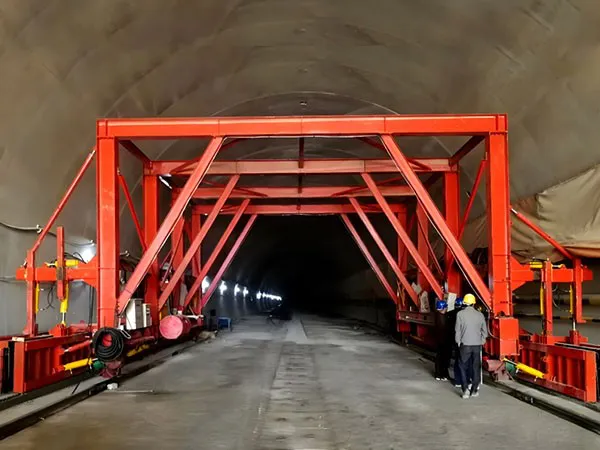
Modern secondary lining trolleys are engineered for automation, combining mobility, stability, and precision to streamline the lining process. These systems are not only safer but also far more efficient than traditional methods.
Key Advantages
Enhanced Efficiency
Trolleys move along the tunnel track, reducing the need for frequent repositioning. What once took several days with manual methods can now be completed in hours, dramatically accelerating project schedules.
Improved Safety
Operators can control the trolley from secure positions, minimizing exposure to heights and heavy concrete handling. Many trolleys are equipped with sensors and automatic shutdown features to further reduce on-site risks.
Precision and Consistency
Advanced trolleys maintain uniform lining thickness and smooth surfaces, ensuring structural integrity and longevity. This level of precision is difficult to achieve consistently with manual methods.
Long-Term Cost Benefits
While the initial investment is higher, reduced labor requirements, faster project timelines, and lower maintenance needs make modern trolleys cost-effective over the lifespan of a project.
Adaptability for Complex Projects
Modern trolleys can navigate various tunnel diameters and complex curves, making them ideal for urban subway lines, hydroelectric tunnels, and other challenging infrastructures.
|
Feature |
Traditional Methods |
Modern Secondary Lining Trolley |
|
Labor Requirement |
High |
Low |
|
Time Efficiency |
Moderate to Low | |
|
Safety |
Moderate Risk |
Low Risk |
|
Lining Precision |
Variable |
High Consistency |
|
Cost |
Low upfront, high labor |
High upfront, lower long-term |
|
Adaptability |
Limited |
Flexible for complex projects |
The construction industry is increasingly shifting toward automation. Modern secondary lining trolleys epitomize this trend, offering tangible benefits in efficiency, safety, and quality. As tunnels become larger and more complex—from metropolitan subway networks to massive hydroelectric projects—the limitations of traditional methods become more pronounced.
By adopting these systems, companies not only accelerate project timelines but also mitigate operational risks and ensure superior structural standards. The versatility and precision of modern trolleys make them a sustainable choice for future-ready tunnel construction.
While traditional secondary lining methods have served the industry for decades, modern secondary lining trolleys are revolutionizing how tunnels are constructed. They deliver faster results, improve safety, ensure higher precision, and provide long-term economic advantages. For contractors and engineers aiming to remain competitive, embracing these advanced systems is not just an option—it’s becoming the industry standard.
Gaofei
Address: 200m east of tulip garden, group 12 of zhangling community, hongshan street office, hongshan town, xigong district, Luoyang
Tel: +8616638856888
Contact: Gaofei Huang
Mobile: +86-18637923976
Phone: 0379-80881719/ 0379-60162687
QQ: 286827457
E-mail: gaofei@gf-bridge-tunnel.com